
UVTAB unveils new guidelines to promote inclusive TVET assessment for learners with disabilities
Extracted from PML Daily.
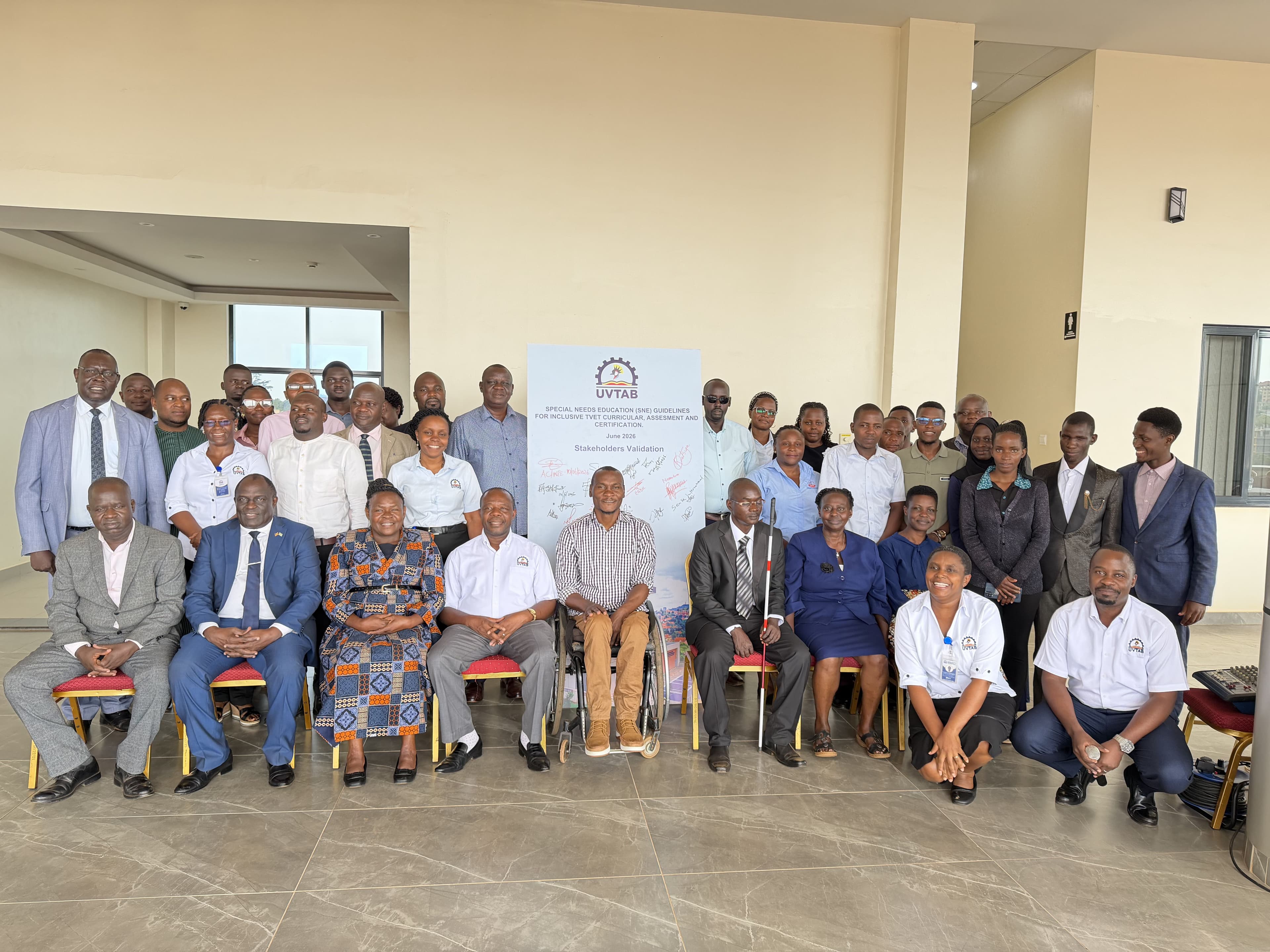
KAMPALA – The Uganda Vocational and Technical Assessment Board (UVTAB) on Wednesday convened a stakeholders’ meeting to validate Special Needs Education (SNE) Inclusion Guidelines aimed at making Technical and Vocational Education and Training (TVET) curricula, assessment, and certification more inclusive for learners with disabilities and other special educational needs.
The meeting brought together education officials, special needs education experts, development partners, and training providers to discuss the implementation of the guidelines, which are expected to strengthen equitable access to vocational training and assessment across the country.
Speaking on behalf of UVTAB Executive Secretary Onesmus Oyesigye, Principal Curriculum Specialist Peter Oyo said the board remains committed to ensuring that assessment and certification systems are accessible, reliable, and responsive to the diverse needs of all trainees.
Oyo explained that UVTAB is mandated to develop and review TVET curricula, assess and certify competencies, accredit assessment centres, and recognize skills acquired through both formal and informal learning pathways.
“In line with the Government of Uganda’s commitment to inclusive development and the principle of leaving no one behind, a Special Needs Education Unit has been established to coordinate and promote inclusion across all functions,” Oyo said.
He noted that the participation of learners with special needs in TVET assessments has steadily increased, with hundreds of candidates with disabilities, refugees, and other vulnerable groups having been registered and assessed in recent years.
“The new Inclusion Guidelines provide a framework to ensure consistency, fairness, and quality in the delivery of inclusive assessment services. They will strengthen our efforts to implement national policies, support government priorities, and enhance quality assurance mechanisms,” he added.
Oyo also acknowledged the contributions of technical experts, partners, and stakeholders who participated in developing and reviewing the guidelines, urging participants to actively contribute to their successful implementation.
The Ministry of Education and Sports welcomed the initiative, describing it as a major milestone in advancing quality, equitable, and inclusive education.
Assistant Commissioner for Special Needs Education Sarah Ayesiga challenged persistent societal misconceptions and discrimination against persons with disabilities, despite growing awareness and advocacy efforts.
“We are living in an era where the light is on, yet there are still people living in darkness,” Ayesiga said, citing a recent case in which a school reportedly rejected a child living with albinism from joining its boarding section due to harmful myths and misconceptions.
She emphasized that learners with disabilities should be viewed as individuals with abilities, talents, and potential rather than limitations.
“If someone is blind or uses a wheelchair, society often asks, ‘How will you manage?’ instead of asking what support can be provided. Every child has potential, and it is our responsibility to help them explore and develop it,” she said.
Ayesiga said the competency-based curriculum currently being rolled out in Uganda seeks to identify and nurture what learners can do rather than focusing solely on academic performance.
“No child should be left behind or made to feel they cannot contribute because of their body or abilities. These guidelines will help us ensure accessibility, assess potential fairly, and support every learner to succeed,” she said.
She called on vocational institutions, educators, and assessment bodies to commit themselves to admitting, supporting, and fairly assessing learners with disabilities.
Meanwhile, UVTAB’s Allen Ayebazibwe provided an overview of the challenges that prompted the development of the guidelines, highlighting gaps within existing curricula and assessment systems.
According to Ayebazibwe, candidates with visual impairments often struggle to complete practical assessments in areas such as computer applications and photojournalism, while learners with hearing impairments face difficulties in language practical examinations that require speaking skills.
She also pointed to challenges faced by candidates with physical disabilities, including those with one hand or no hands, who are sometimes expected to undertake practical sign language assessments without appropriate accommodations.
“Many of these candidates experience exclusion during training and assessment, including being left out of dormitories or learning activities. As assessors, we often face difficulties in determining the most appropriate support mechanisms,” Ayebazibwe said.
She explained that the newly developed guidelines provide a framework for identifying and addressing such barriers through reasonable accommodations, resource allocation, and inclusive assessment practices.
“The guidelines will ensure that assessment centres uphold the rights of candidates with special needs and provide the necessary support to enable them to demonstrate their competencies fairly,” she said.
Stakeholders were urged to support the implementation of the guidelines and work collectively to create a TVET system where all learners, regardless of disability or circumstance, have equal opportunities to acquire skills, demonstrate competence, and obtain certification.
The validation meeting marks another step in Uganda’s efforts to strengthen inclusive education and ensure that vocational training institutions are equipped to serve all learners without discrimination.